
REVIEW · TOURS
Jewish Tour in Rio de Janeiro
Jewish Rio makes the city feel personal fast, and this 3-hour tour does it without you juggling logistics. I like that you get small-group attention from guides connected to the community, and you also spend real time at places that show how Jewish life has changed in Brazil. A second win is the mix of synagogues, community spaces, and a museum, so you are not stuck with only one kind of stop.
One consideration: a couple major highlights have ticketed entry and some stops are time-limited, so bring patience for short visits and quick photo moments, especially if the sites are busy.
In This Review
- Key highlights worth putting on your Rio map
- Leblon and Ipanema: synagogues by the water
- Botafogo Beach and the ARI synagogue: memory meets daily community
- Botafogo Bay at Itzhak Rabin Park: a viewpoint with political symbolism
- Museu Judaico do Rio: a compact museum with real research muscle
- Grande Templo Israelita do Rio: architecture, decline, and partial access
- How the 3-hour format actually feels in Rio
- Price and value: what $95 buys, and what it does not
- Who should book this Jewish Rio tour (and who might want a different approach)
- Should you book Jewish history in Rio with this group tour?
- FAQ
- How long is the Jewish Tour in Rio de Janeiro?
- What time does the tour start, and where does it begin?
- Is hotel pickup and drop-off included?
- Is pickup available for cruise passengers?
- How big is the group?
- What is included in the price?
- Are entrance fees included?
- Is this tour suitable for children?
- What is the cancellation policy?
Key highlights worth putting on your Rio map
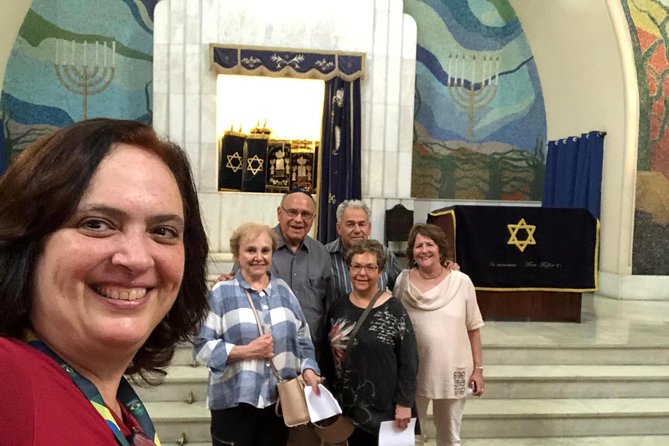
- Small group (max 14), so it feels like an actual guided morning, not a loud bus tour
- Hotel and port pickup/drop-off included, which is a big deal in a sprawling city
- Beit Lubavitch Synagogue and Midrash Cultural Center in Leblon, plus community stops around the beaches
- Anne Frank school connection in Botafogo, tying local education to global memory
- Jewish Museum of Rio (Museu Judaico) with study and research resources, not just a few display cases
- Grande Templo Israelita do Rio for architectural and historical context, even though access can be limited
Not sold yet? Here is what else scored well across Rio de Janeiro.


Leblon and Ipanema: synagogues by the water
This tour starts by steering you toward the upscale beach stretch where Rio’s neighborhoods start to feel different block by block. Leblon is the kind of area where prices rise with the skyline, and that contrast helps you understand how Jewish institutions in Rio have grown alongside the city’s shifting geography.
In Leblon, you focus on two places tied to learning and tradition: the Beit Lubavitch Synagogue and the Midrash Cultural Center. The best part here is not only what the buildings represent, but how the guide frames Jewish life as something educational and ongoing, not just ceremonial. You get quick orientation, then you’re able to look at the details without feeling lost.
From there, you move into the wider beach-zone feel between Ipanema and Arpoador, where the streets and sand are always doing something. This matters on a heritage tour because it prevents the sites from feeling like isolated islands. You also stop by the CIB Jewish Community Center, which helps connect the idea of community to a real place where people show up for daily life, not just holidays.
Practical note: this part of Rio is photogenic and busy. Wear sunscreen, keep your phone ready, and expect the guide to work in tight time windows. If you have mobility limits, mention it early, because beach areas can involve uneven walking even when the stops are short.
Botafogo Beach and the ARI synagogue: memory meets daily community
Botafogo is a classic “postcard view” moment in Rio, with that big open sightline that makes you understand why people fall in love with this city. This stop is less about one building and more about the setting, because the guide uses the views to anchor stories about where Jewish residents have lived and worked.
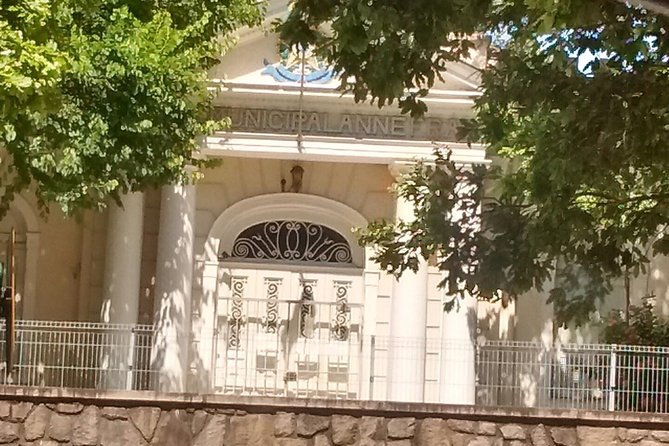
One of the most striking connections here is the Anne Frank municipal school, part of a network of schools named for her through CONIB. Even if you have read about Anne Frank elsewhere, seeing the connection in Rio grounds the story in local education and civic values. You get an explanation that links the idea of remembrance to respect and human rights, not only to history as a past event.
You also have time around the area for the A.R.I. synagogue, associated with progressive Judaism in Rio. This is one of the ways the tour avoids a single-lane version of Jewish identity. You see how different denominations and community approaches can coexist in the same city, with shared responsibility for education and remembrance.
What I like about this stop is that it balances solemn themes with everyday reality. A heritage tour can sometimes drift into theory, but here you keep returning to institutions that still function, still teach, and still bring people together.
Botafogo Bay at Itzhak Rabin Park: a viewpoint with political symbolism
Then you shift from beach views to a viewpoint that feels like a mini history lesson in itself: Itzhak Rabin Park in Botafogo, set on top of Morro de Pasmado. If you’ve ever wondered how a city can hold layered meanings in simple public spaces, this is a good example.
The park gives you elevated sightlines over the Botafogo Bay and toward nearby areas like Urca Bay. The visual payoff is real, but the guide also points to the bust of Itzhak Rabin, using it as a way to explain the relationship between the Brazilian state and Israel. In other words, the viewpoint is not only for photos, it is for context.
This stop runs short, which is smart. It prevents the schedule from dragging while still giving you something that feels distinct from the synagogue-and-museum blocks. For a 3-hour morning, it adds variety without wasting time.
Tip: go in with a quick mindset. You get a chance to look and understand, then you move on. If you try to “study the whole park,” you’ll feel rushed.
- Rio de Janeiro: 6-Stop Highlights of Rio with Lunch
★ 4.4 · 5,157 reviews - Christ the Redeemer Entry Ticket by Corcovado Train
★ 4.4 · 4,476 reviews - Rio de Janeiro: Rocinha Favela Walking Tour with Local Guide
★ 4.8 · 3,052 reviews - Rio: Christ the Redeemer, Sugarloaf, Selaron & BBQ Lunch
★ 4.5 · 2,428 reviews - Rio De Janeiro: Half-Day Rocinha Favela Walking Tour
★ 4.7 · 2,272 reviews
Museu Judaico do Rio: a compact museum with real research muscle
Now you step into Museu Judaico do Rio de Janeiro, and this is where the tour’s “why this matters” side gets serious. The museum was founded in 1977, and it has a mission built around preserving memory while promoting Jewish culture across religious, cultural, and historical angles.
This is not a huge building with endless galleries, so don’t expect a full day inside. Instead, it’s structured as a cultural center connected to broader activities in the city. Regular exhibits cover the history of the Jewish community in Rio and Jewish traditions, and the museum also supports academic research related to migration.
The most useful detail for you, if you like learning that goes beyond wall text, is the museum’s behind-the-scenes work. It includes a Study Center focused on migration and the Holocaust, a video archive with over a thousand films, and a library. Even if you never tour those deeper resources in detail during your visit, knowing they exist changes how you interpret the exhibits. You are seeing a living organization, not a static collection.
Admission is not included, so plan for that extra cost. Also, time here can vary depending on what is open and how the guide is pacing the group.
If you want a simple takeaway, it is this: this stop helps you understand Jewish Rio as part of bigger stories, migration and memory, with Brazil as the living backdrop.
Grande Templo Israelita do Rio: architecture, decline, and partial access

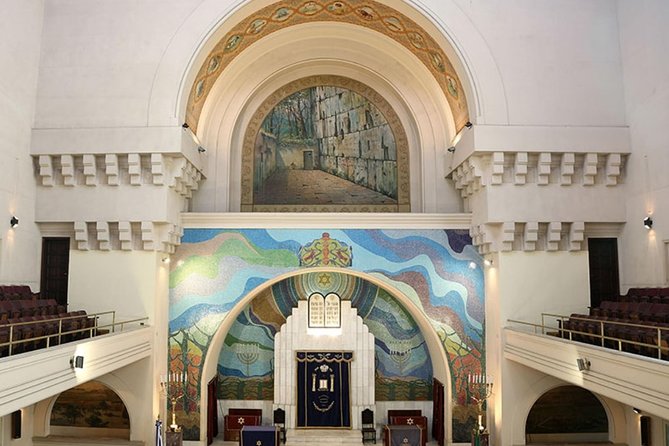
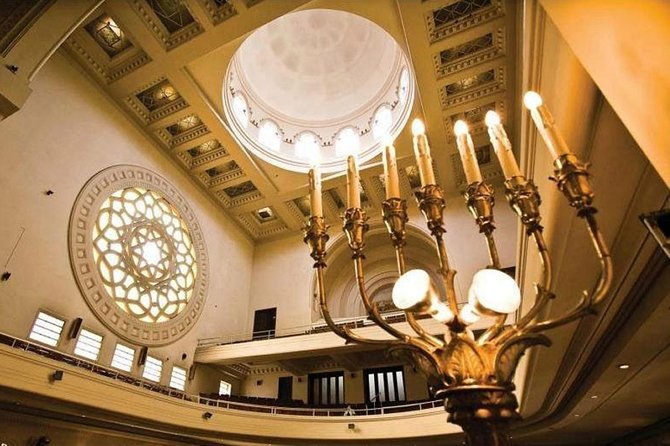
The final major stop is Grande Templo Israelita do Rio de Janeiro, the largest monument of the Jewish community in Rio. The tour frames it as connected to the history of the Yishuv and the city’s Jewish development. You can feel that weight when you look at the building style and the way it was designed to be seen.
This temple is Ashkenazi, and the architecture is described as eclectic, with elements of Hebrew origin mixed with classical features. The design was elaborated in 1919 by architect Vodred, and the temple opened in 1932. The mosaics were created in 1976 by artist Humberto Cozzo, and the building suffered a collapse in 1987.
Here is the practical reality: it is not regularly open like a typical synagogue. It is open only during high holidays, special events, and tourist visits. That means your access during the tour depends on the schedule for that day, not just the fact that the temple exists.
I like this stop because it makes the story feel honest. Heritage sites are not all preserved at full strength, and Rio has its share of buildings with complicated timelines. You get architectural context plus the reminder that communities also deal with setbacks.
Bring the right expectations: treat it as a historical look rather than a long worship-style visit.
How the 3-hour format actually feels in Rio
This is a 3-hour tour, built for a morning slot at 9:00 am, and you return to the starting area afterward. That timing matters. In Rio, mornings can be cooler, and you dodge some of the day’s heat and traffic creep.
The schedule also moves efficiently between neighborhoods, which is why the transport is included. You ride in a vehicle by car or van, and the small group size keeps it from feeling like you’re constantly waiting for people to catch up.
Time at each stop is modest, so the guide’s job is to give you the “thread” that connects the locations. In practice, that means you learn how institutions differ, how denominations show up in real spaces, and how education and memory work have local expression.
If you care about photos, you’ll get them, but this is not a photo safari. You’ll want a quick, clean routine: water, sunscreen, and a charged battery. Also, if someone in your group needs the restroom, don’t assume you will automatically know where the group reconvenes. One downside mentioned in a negative experience involved a missed meeting point inside a stop, which is a good reminder to confirm the exact gathering place before stepping away.
Price and value: what $95 buys, and what it does not
At $95 per person, you are paying for a guided morning with included transport plus pickup and drop-off. The included items are a professional guide, hotel pickup and drop-off (selected hotels), port pickup and drop-off, and transport by vehicle. That reduces the biggest hassle in Rio, trying to coordinate cabs between scattered neighborhoods.
Entrance fees are the key variable. Some stops list admission as free, while others are not included. The museum and the Grande Templo have ticketed access on your own, so factor that into your budget. In other words, the price is fair if you plan for a small extra cost at the ticketed sites.
For cruise travelers, this can be especially good value because port pickup is included. For land-based visitors, hotel pickup saves time and avoids that “where do I stand?” moment with taxis and traffic.
Who should book this Jewish Rio tour (and who might want a different approach)
This tour is a great fit if you want a clear introduction to Jewish Rio without turning the day into a self-guided scavenger hunt. It also works well if you like a balance of themes: synagogues, community institutions, education links, and a museum focused on memory and culture.
It is also well suited for people who appreciate local context. The guides’ Rio roots come through in the way they talk about community spaces and how the city connects to Jewish identity. Names that show up in guide experiences include Ephraim, Gisela, Leonardo, Katya, and Edwardo, and the common thread is strong storytelling tied to the buildings.
You might consider a different tour if you want lots of time inside every site. The stops are short by design, and the museum and temple have limited access patterns. Think of it as an informed highlight reel with practical context, not a slow, deep stay at each location.
Should you book Jewish history in Rio with this group tour?
If your goal is to get oriented quickly and learn how Jewish life has taken shape across Rio’s neighborhoods, I think this is a smart way to do it. The small-group format and included pickup remove the stress that can flatten a heritage day.
Book it if you’re okay with a 3-hour pacing plan and you are willing to pay additional entry for the museum and the temple. Skip it if you need long museum time or you want to explore at your own rhythm without fixed meeting points.
If you do book, send a message ahead about your pickup spot and make sure everyone in your group knows where you’ll meet at each stop before going off for a quick look or restroom break.
FAQ
How long is the Jewish Tour in Rio de Janeiro?
The tour runs about 3 hours.
What time does the tour start, and where does it begin?
It starts at 9:00 am at Hilton Rio de Janeiro Copacabana, Av. Atlântica, 1020, Copacabana, Rio de Janeiro.
Is hotel pickup and drop-off included?
Yes, hotel pickup and drop-off are included for selected hotels.
Is pickup available for cruise passengers?
Yes, port pickup and drop-off are included.
How big is the group?
The tour has a maximum of 14 travelers.
What is included in the price?
The price includes a professional guide, hotel or port pickup and drop-off (where applicable), and transport by car or van.
Are entrance fees included?
Not all of them. Entrance fees are not included, though some stops in the itinerary list admission as free.
Is this tour suitable for children?
Children must be accompanied by an adult.
What is the cancellation policy?
You can cancel for free up to 24 hours in advance for a full refund. If you cancel less than 24 hours before the start time, the amount paid is not refunded.
Everything Else We Rated in Rio de Janeiro
More Tour Reviews in Rio de Janeiro
More Tour Reviews in Rio de Janeiro
Latest from our Rio de Janeiro notebook
- Unforgettable Boat Party★ 5.0 · 3 reviews
- Tijuca National Park and all its wonders!★ 5.0 · 3 reviews
- Rocinha Jeep Tour: A Journey into the Soul of the Favela!★ 3.8 · 3 reviews
- Rio: Favela Walking Tour of Rocinha with a Resident Guide★ 4.7 · 3 reviews
- Rio: Private, Custom express, Main Attractions!★ 5.0 · 3 reviews
- Rio: Museum of Tomorrow, Yup Star & Olympic Boulevard★ 3.7 · 3 reviews
Tours, compared.
 ★ 4.8Rocinha Favela Walking Tour with Local GuideFrom $363,052 reviews
 ★ 4.7Half-Day Rocinha Favela Walking TourFrom $352,272 reviews
 ★ 4.6Angra dos Reis and Ilha Grande Full-Day TourFrom $771,673 reviews
 ★ 4.9Iguazu Falls: Full-Day Tour of Brazil & Argentina SidesFrom $631,542 reviews
 ★ 4.8Sunset Sailing TourFrom $75994 reviews
 ★ 4.7Christ, Selaron Steps, and Tijuca Park TourFrom $68857 reviews
 ★ 4.9Sunset Sailboat Tour with Open BarFrom $57785 reviews
 ★ 4.3Guided Jeep Tour through Tijuca RainforestFrom $90740 reviews