
REVIEW · CYCLING TOURS
Bike Tour of the 4 Scales of Lucio
Brasília is better at bike speed. This 7-hour loop lines up major Niemeyer icons, Lúcio Costa planning ideas, and real city texture, with free admission tickets at every planned stop. My favorite part is how the route keeps changing gears, from towers and parks to superblocks and the civic core, so you stop seeing Brasília as a postcard.
What I really like is the mix of design and culture, especially the stop at Clube do Choro tied to Raphael Rabello and Brazil’s first cavaquinho school. If you get a guide like Rui or Daniel, you can expect clear explanations and smooth handling of intersections. One thing to keep in mind: bike fit can vary, and a ride that runs late means you may want to have good visibility plans in mind if you are sensitive to evening light.
In This Review
- Key highlights before you pedal
- Why this Lúcio Costa bike route works in Brasília
- Meeting point and how the day starts
- The itinerary, stop by stop, and what each one teaches you
- Stop 1: Torre de Televisão, then a quick craft-fair pass
- Stop 2: Clube do Choro, plus the music-school engine of the city
- Stop 3: Parque da Cidade Sarah Kubitschek, a big green pause
- Stop 4: Renato Russo Hall, then you move back to residential logic
- Stop 5: SQS 308 Quadra modelo, the model superblock moment
- Stop 6: Igrejinha Nossa Senhora de Fátima, Athos Bulcão tiles outside
- Stop 7: Superquadra Sul 302, residential scale in action
- Stop 8: Palácio Itamaraty, Niemeyer diplomacy building
- Stop 9: Santuario São João Bosco and the Cathedral Metropolitana
- Passing moments: Rua das Farmacias and its everyday commerce
- Stop 10: Praça do Povo, renovated 2021, and a multi-use public square
- Stop 11: Museu Nacional da República and the Setor Comercial Sul flow
- Lelé architecture break: the Sarah Hospitals network first unit
- Stop 12: Praça dos Três Poderes, plus the model civic layout
- Stop 13: Espaço Lucio Costa, underground models in 1992
- Stop 14: Supremo Tribunal Federal and Stop 15: National Theatre
- Cultural corridor passes: Espaço Cultural Renato Russo, libraries, and the presidential dispatch place
- Stop 16: Panteão da Pátria and Stop 17: Jardim Burle Marx, then the ministries Esplanade
- Price and value: why $97.03 can make sense
- Bikes, helmets, and pacing: what to expect on the ground
- Sustainability note that matters in real terms
- Who this tour suits best
- Should you book the Bike Tour of the 4 Scales of Lúcio Costa?
- FAQ
- FAQ
- How long is the Bike Tour of the 4 Scales of Lucio?
- What is the price per person?
- Is the tour admission free at the stops?
- What does the tour include?
- Is lunch included?
- Where does the tour start and end?
- How big is the group?
- Are helmets mandatory?
- Can children ride on a tandem passenger trailer?
- What if the weather is bad?
- Can I cancel for a full refund?
Key highlights before you pedal
- Every stop is listed with free admission, so your cost stays predictable.
- Clube do Choro brings you inside a music school tradition, not just monuments.
- Model superblock time at SQS 308 helps you understand Brasília’s residential logic quickly.
- Niemeyer’s civic cluster moves from Cathedral to Palácio Itamaraty and the Three Powers area.
- Urban life breaks, like Rua das Farmacias and Praça do Povo, show Brasília beyond the big buildings.
- Small group size (max 15) keeps the pace comfortable and the guidance hands-on.
Saddle time around Brasilia
Why this Lúcio Costa bike route works in Brasília
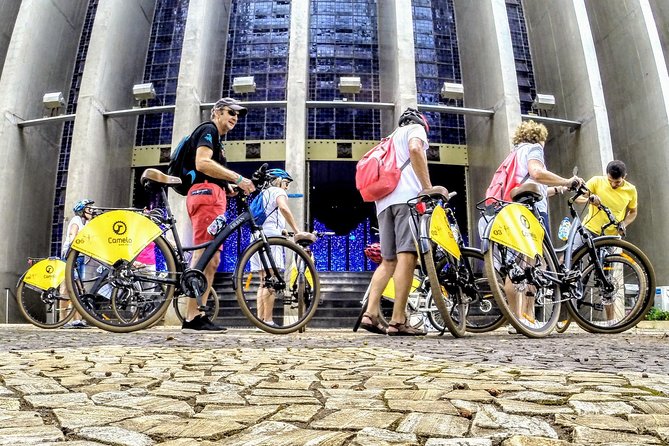
Brasília has a reputation for being planned and diagrammed. This bike tour gives you the same lesson, but with wheels. You get the big names, Oscar Niemeyer and Lúcio Costa, yet you also ride through the layers of daily use that make Brasília feel lived-in.
The value comes from three practical choices. First, nearly every scheduled stop is marked as free admission, so you are not constantly thinking about tickets. Second, the tour includes basics that matter on a ride, like two 500 ml bottles of mineral water and an offered helmet. Third, the day is designed as a sequence, not a single long museum slog. You change contexts every 10 to 45 minutes.
The biggest upside for most people is access. On foot, Brasília can feel wide and spaced out. By bike, you can reach model superblocks, civic monuments, and commercial streets without burning the whole day on transit.
Meeting point and how the day starts
The tour meets at Camelo Bike Tour Brasília, SHS Quadra 06, Conjunto A, Bloco A, Loja 17, Centro Empresarial Brasil 21, in Asa Sul. It also ends back at that same meeting point, so your navigation stays simple.
Expect a small group, up to 15 riders. There is an articulated tandem passenger trailer option for children aged 4 to 10 or 12, if you ask in advance. For families, that is a big deal, because it means the main plan can still work instead of you splitting off to manage logistics.
Guides can make or break a bike day in any city. This operator has clear examples of that from past rides, including Larissa, Romain, Rui, and Daniel. In particular, Daniel’s style stood out for helpful cross and semaphore control, plus making time for photos without turning the day into chaos.
The itinerary, stop by stop, and what each one teaches you
- Civic, Legal and Architectural Citytour
★ 4.5 · 81 reviews - Private city tour in Portuguese, English and Spanish.
★ 5.0 · 73 reviews - City Tour Brasilia
★ 5.0 · 40 reviews - Brasilia : Private Custom Tour with a Local Guide
★ 4.7 · 30 reviews
Stop 1: Torre de Televisão, then a quick craft-fair pass
You start at the Television Tower pilotis area. It is a natural first stop because it puts you in the Brasília frame early, with a landmark that feels like a built-in starting line. The listed time is 30 minutes, and the admission ticket here is free.
Right after, you pass by the TV Tower craft fair. This is a good moment for a quick snack-style browse or to pick up something small. It is also the kind of informal stop that helps you settle into the rhythm of the day before the circuit tightens.
Why it matters: starting at a tall, iconic structure helps you understand scale fast. Brasília can be hard to judge until you see it from a reference point.
Stop 2: Clube do Choro, plus the music-school engine of the city
Clube do Choro is one of the most interesting cultural stops on the route. You visit the concert hall tied to Niemeyer, aimed at around 500 people, where the Choro School also runs.
This is where the tour gets very specific in a good way. The stop notes the school has more than a thousand students learning instruments like cavaquinho, mandolin, tambourine, guitar, saxophone, flute, accordion, harmonica, violin, and viola caipira. You are not just told that Brasília has culture, you get a concrete sense of what people practice there.
There is also a mention that the Clube do Choro stage took on a solo-sacred status after Paul McCartney’s surprise, intimate performance on November 28, 2023. Even if you do not chase pop-culture history, it adds weight to why this hall is meaningful.
You also have an intermediate pass involving the Ulysses Guimarães Convention Center, described as one of Brazil’s most modern facilities. It is huge, with capacity for 9,400 people across 54,000 square meters, designed by Sérgio Bernardes, and close to government areas and major hotels. The time listed for the surrounding pass is short, so treat it as a visual connection, not a full visit.
Potential drawback: this portion can feel like it shifts from music culture to another building description quickly. If you prefer a slower pace, use the bike motion as a way to reset mentally and let the guide’s explanations do the heavy lifting.
Stop 3: Parque da Cidade Sarah Kubitschek, a big green pause
Then you ride into Parque da Cidade Sarah Kubitschek. It is framed as one of the largest urban parks in the world, with 25 minutes scheduled and free admission.
This is not a random break. Parks help you understand the city’s open-space thinking. Brasília often feels like it has breathing room built into the plan, and this is where you feel that in your body, not just in photos.
What I like about this stop: it is a breathing space right in the middle of a design-heavy day. Your brain gets a rest from monuments while your eyes keep adjusting to the scale of Brasília.
Stop 4: Renato Russo Hall, then you move back to residential logic
After the park, the route includes a stop linked to Renato Russo Hall. The time listed is not shown in your excerpt for this segment, but the tour timing keeps it as a quick marker before you shift into the superblock theme again.
This is a classic Brasília rhythm. You jump between cultural landmarks and planning concepts. The goal is to show how the city’s sections connect, not just to accumulate photos.
Stop 5: SQS 308 Quadra modelo, the model superblock moment
SQS 308 in Asa Sul is the model court. It is tied to Lúcio Costa’s selection, with urbanism and landscaping by Burle Marx, and construction by Banco do Brasil. It was inaugurated on February 19, 1962.
You get 45 minutes here, which is generous. This matters because superblocks can be confusing if you glance at them once. With time, you can actually notice the logic: building projections, lots, and the mix of nearby services and leisure areas.
The tour uses this stop to give you the language of Brasília’s residential planning. If you want your visit to make sense, this is a must.
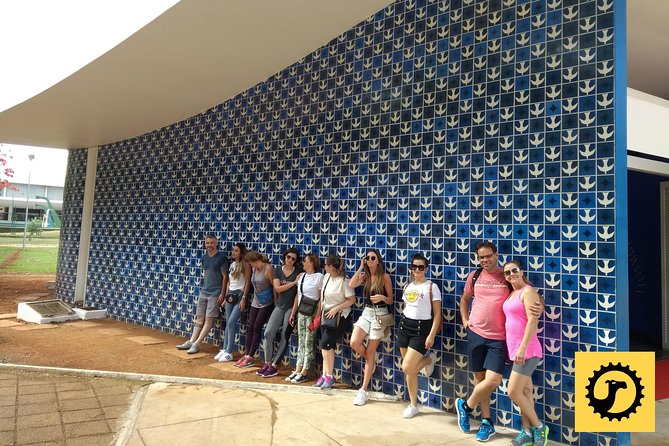
Stop 6: Igrejinha Nossa Senhora de Fátima, Athos Bulcão tiles outside
Then you roll to Igreja Nossa Senhora de Fátima, inaugurated in June 1958. It is described as the first church located in the residential sector, raised at Dona Sarah Kubitschek’s request.
The exterior features tiles by Athos Bulcão with stylized figures tied to dove imagery and the star of the Nativity. You get 20 minutes, and it is free to enter.
Why it fits the tour: Brasília’s plan includes not only government buildings, but community anchors inside residential areas. This church helps you see that idea in a tangible way.
Stop 7: Superquadra Sul 302, residential scale in action
Next comes Superquadra Sul 302, described specifically as part of the Residential Scale conceived by Lúcio Costa. It is not the first Superquadra, but the configuration is similar to the model court, including the projections and the presence of local shops, schools, and leisure areas.
This segment is listed for 15 minutes and is free. It is a short follow-up meant to reinforce what you noticed at SQS 308, but with a real-feeling neighborhood comparison.
If you are the kind of traveler who likes to connect theory to street-level reality, you will enjoy this. If not, keep it simple: treat it as the contrast that turns model into lived-in.
Stop 8: Palácio Itamaraty, Niemeyer diplomacy building
Palácio Itamaraty, also known as Palácio dos Arcos, is a Niemeyer work that anchors the tour’s move into the civic and diplomatic atmosphere. You get 10 minutes, admission free.
You are not here for a long museum experience. It is a quick read on the city’s authority structures, and it helps you understand how architecture and power talk to each other in Brasília.
Stop 9: Santuario São João Bosco and the Cathedral Metropolitana
Two iconic religious stops follow: Santuario São João Bosco, then Catedral Metropolitana by architect Oscar Niemeyer. Each is listed with 15 minutes and free admission.
The sanctuary is built for St. John Bosco, the patron saint of Brasília. The Cathedral is highlighted as a milestone in modern architecture and Brasília’s history.
These stops work because they give you a human-scale counterpoint to the political monuments. After the civic intensity, you get structures that feel spiritual and monumental at the same time.
Tip: if you arrive during bright daylight, your phone photos may blow out shadows. If you can, pause a minute and let your eyes adjust before shooting.
Passing moments: Rua das Farmacias and its everyday commerce
The route passes by Rua das Farmacias, a street dominated by pharmacies due to proximity to the South Medical and Hospital Sector. You will not be stopping for a long walk here, but it is part of how the tour proves its point: Brasília has everyday rhythms.
Stop 10: Praça do Povo, renovated 2021, and a multi-use public square
In the South Commercial Sector (SCS), the tour includes Praça do Povo. You get an explicit note that it was renovated in 2021, won an IAB award in the Midwest for Urbanism, Planning and Cities, and was inaugurated in October 2021.
The tour frames the new design as functional and improvements focused on urban quality. It supports skateboard practice, shows, and kiosks. Time listed is not shown for this specific segment, but it is treated as a real urban-use pause, not a photo-only stop.
I like this part because it challenges the common view of Brasília as purely monumental. Here you see how people actually use public space.
Stop 11: Museu Nacional da República and the Setor Comercial Sul flow
You visit Museu Nacional da República for 5 minutes, free admission. The route notes it is within a cultural complex planned in Brasília’s original plan, with a project commissioned by Niemeyer in the 1970s.
Then you ride through Setor Comercial Sul, described as central to Brasília and a major pedestrian flow during weekdays because of services and institutions near bus connections and the Esplanada dos Ministérios. The tour highlights revitalizations and buildings by architects like Lelé and Niemeyer. It also frames the sector as similar in spirit to Europe’s Champs Élysées or La Rambla, basically a place people use and wander.
This part is where you can feel the city’s pulse. Even if you do not stop much, your bike movement through commercial flow is a useful kind of understanding.
Lelé architecture break: the Sarah Hospitals network first unit
The route includes a stop pass about the Sarah Hospitals Network, described as the first unit of the network focused on rehabilitation specializing in locomotion and orthopedic diseases.
The description stresses the design choices: humanized spaces that do not look like typical hospitals, large multicolored airy environments with natural ventilation and lighting, and a rationalized construction system. It also credits architect João da Gama Filgueiras Lima, known as Lelé, for attention to construction methods and detailing.
You get a sense here that Brasília’s design ambitions also apply to care and long-term recovery environments. The tour uses this as a meaningful contrast to purely official buildings.
Stop 12: Praça dos Três Poderes, plus the model civic layout
Now you reach one of the core civic zones: Praça dos Três Poderes. It was inaugurated on April 21, 1960, created by Lúcio Costa and designed by Oscar Niemeyer. Admission is free, time listed 20 minutes.
This is where the tour’s planning thesis becomes obvious. You see how Brasília uses space to stage the relationship between institutions and the public.
Stop 13: Espaço Lucio Costa, underground models in 1992
Next is Espaço Lucio Costa, inaugurated February 27, 1992 for Lucio Costa’s 90th anniversary. The tour describes it as an underground construction housing the Brasilia Model and the Plano Piloto Tactile Model.
Time listed is 15 minutes, free entry.
If you want your later photos to mean something, this stop helps. It is a quick way to see the plan’s physical logic and how scale works. The tactile model also hints that the city’s plan-thinking can be experienced through touch, not only sight.
Stop 14: Supremo Tribunal Federal and Stop 15: National Theatre
The tour then includes the Supremo Tribunal Federal, situated on the third vertex of Praça dos Três Poderes, opposite Planalto Palace, designed by Oscar Niemeyer with Lucio Costa’s original design involvement. Time listed is 5 minutes, free admission.
Then you have the National Theatre, the Claudio Santoro National Theater, described as one of the most beautiful works in Brasília. Time listed is 10 minutes, free.
These stops are short but important. They add layers to the civic triangle, so you are not just seeing the facade. You feel how different powers get different architectural treatments.
Cultural corridor passes: Espaço Cultural Renato Russo, libraries, and the presidential dispatch place
After Cultura Inglesa and Aliança Francesa and Praça 21 de Abril passes, the tour heads to Espaço Cultural Renato Russo 508 south. The description says it includes rooms, galleries, and theaters with different profiles for artistic and cultural presentations in various languages. It specifically mentions two theaters, Teatro Galpão and the renovated Teatro de Bolso.
The route also includes a stop pass for the National Library of Brasília, and a note that this is where the President of the Republic dispatches. In practical terms, that is part of the same civic core experience.
Time for these internal segments is not fully specified here, but your total tour time is around 7 hours, so it should feel like a guided flow through dense central-area points.
Stop 16: Panteão da Pátria and Stop 17: Jardim Burle Marx, then the ministries Esplanade
You wrap with Panteão da Pátria, described as the Pantheon of the Fatherland, for 5 minutes, free.
Then you ride to Jardim Burle Marx, with 10 minutes scheduled and free admission. Burle Marx’s garden work is a fitting finale because it returns you to the human-scale details, plants, paths, and shade.
Finally, you finish with the Ministries Esplanade. This is the signature long axis view of Brasília’s government architecture. Even if you only get a short segment, the combination of earlier model superblock logic and later civic staging makes the whole city read more clearly.
Price and value: why $97.03 can make sense
At $97.03 per person for about 7 hours, this is not a cheap activity. But the structure helps the math.
You are getting:
- bicycle included
- helmet offered (use is not mandatory)
- two bottles of 500 ml mineral water
- admission tickets listed as free for the planned stops
Also, the route runs with a small group max of 15. That is often where bike tours either feel personal or feel crowded.
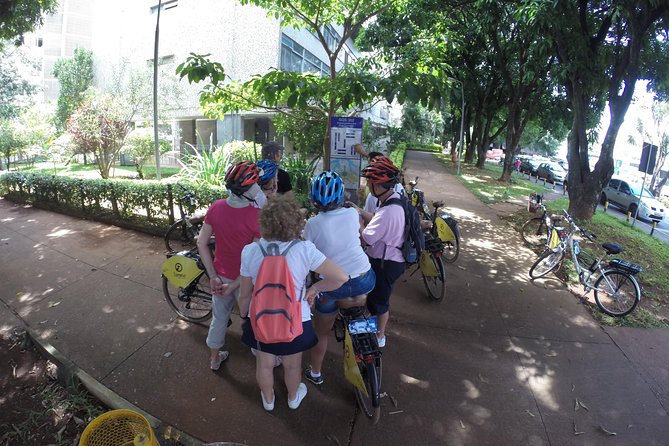
There is one caution from real rides: some people found the bikes could be in better shape for the price. Another rider had trouble because the selection was not as wide as needed for shorter women. For you, that means it is worth paying attention during the bike fit check. If the seat height and handlebar reach do not feel right quickly, ask for a switch early, not after you have ridden for an hour.
If the day runs into evening and you are photosensitive, consider adding your own light. Helmets can be great, and one review suggestion asked for lights on helmets or bikes for visibility during nighttime conditions. The operator says lights exist for nighttime tours in their response, but adding your own small light can still give you peace of mind if you are sensitive to low light.
Bikes, helmets, and pacing: what to expect on the ground

You ride a provided bicycle with a helmet offered. Helmet use is not mandatory in Brazil, but you should still wear it, especially in areas with busy crossings.
The pacing depends on your group and your guide. The tour description shows short times at many stops, with 5 to 10 minutes sprinkled into the civic core. That is intentional. You are meant to get guided context without losing momentum.
The circuit also includes stops where you might have to switch brain modes quickly, from park walking to building exterior reading to cultural interior moments. If you tend to get tired during transitions, bring water and take advantage of any seatable pauses.
One practical tip based on past experiences: arrive ready to adjust the bike. Seat and reach checks can take time. One review mentioned spending time testing bicycles to make the fit correct, and that is a healthy sign, not a problem, as long as it gets done early.
Sustainability note that matters in real terms
One response you will see associated with this tour mentions recognition by Embratur and Sebrae Nacional as one of the 100 best sustainable experiences in Brazil. For me, that is not just a badge. A car-light or transit-light approach helps reduce the environmental pressure of seeing a city like Brasília, and bike travel is usually the simplest practical sustainability upgrade for visitors.
Who this tour suits best
This is ideal if you:
- want architecture and urban planning context without sitting on a bus all day
- like a mix of monumental stops and everyday city streets
- prefer bike access so you can move between dispersed landmarks efficiently
- want free admissions included in the schedule
It is also a good choice if you travel with kids, thanks to the articulated tandem passenger trailer option for ages 4 to 10 or 12, if requested in advance.
If you have mobility limits that make cycling difficult for 7 hours, this may not be your best match. Your fit and stamina matter here, because the itinerary covers a lot of ground even with shorter stops.
Should you book the Bike Tour of the 4 Scales of Lúcio Costa?
Yes, if you want a clear reading of Brasília that goes beyond icons. The itinerary does a good job switching between model planning ideas and real neighborhood life, and the free admission structure keeps the day feeling straightforward.
I would book with extra care if:
- you are worried about bike sizing and you want a guaranteed snug fit
- you are traveling late in the day and low light makes you uneasy, in which case bring or plan for strong visibility
- you care about long interior time at a single museum, because several stops are intentionally short
If you show up ready for bike fitting, wear your helmet, and go with curiosity about how Brasília is organized, you should have an excellent time. And if you end up with a guide like Larissa, Romain, Rui, or Daniel, you will likely get the kind of calm direction that makes a bike day in Brasília feel effortless.
FAQ
FAQ
How long is the Bike Tour of the 4 Scales of Lucio?
It is about 7 hours (approx.).
What is the price per person?
The price is $97.03 per person.
Is the tour admission free at the stops?
The itinerary lists free admission tickets for the planned stops.
What does the tour include?
It includes use of the bicycle, bottled water (two bottles of 500 ml mineral water), and a helmet offered for riders.
Is lunch included?
No, lunch is not included.
Where does the tour start and end?
It starts at Camelo Bike Tour Brasília in Asa Sul and ends back at the same meeting point.
How big is the group?
The tour has a maximum of 15 travelers.
Are helmets mandatory?
Helmets are offered, and their use is not mandatory in Brazil.
Can children ride on a tandem passenger trailer?
Yes, there is an articulated tandem passenger trailer for children from 4 to 10 or 12 years old, if you ask in advance.
What if the weather is bad?
This experience requires good weather. If it is canceled due to poor weather, you will be offered a different date or a full refund.
Can I cancel for a full refund?
Yes. You can cancel up to 24 hours in advance for a full refund. If you cancel less than 24 hours before the start time, the amount paid is not refunded.
Everything Else We Rated in Brasilia
More Tour Reviews in Brasilia
More Tour Reviews in Brasilia
Latest from our Brasilia notebook
- Brasilia : Private Custom Tour with a Local Guide★ 4.7 · 30 reviews
- Pirenópolis, the charming baroque city inaugurated in 1723 in the gold cycle★ 4.5 · 40 reviews
- City Tour Brasilia★ 5.0 · 40 reviews
- Bike Tour of the 4 Scales of Lucio★ 5.0 · 49 reviews
- Fatima Neighborhood and Church Unit Bike Tour★ 5.0 · 58 reviews
- Civic, Legal and Architectural Citytour★ 4.5 · 81 reviews
Cycling Tours, compared.
 ★ 4.9Downtown Historical Bike TourFrom $85191 reviews
 ★ 4.5Guided Bike Tours in Small GroupsFrom $36133 reviews
 ★ 5.0Fatima Neighborhood and Church Unit Bike TourFrom $6258 reviews
 ★ 5.0Street Art and Park Bike TourFrom $8556 reviews
 ★ 5.0Half Day Private E-Bike Tour in RioFrom $12050 reviews
 ★ 5.0Private Bike Tour in ParatyFrom $6343 reviews
 ★ 5.0Small-Group Urban Bike Tour in Rio de JaneiroFrom $3941 reviews
 ★ 4.5Pirenópolis, the charming baroque city inaugurated in 1723 in the gold cycleFrom $22040 reviews
Browse the lists this tour appears in