
REVIEW · HISTORICAL TOURS
Rio’s city walking tour: a glimpse of history and olympic legacy
Old Rio has a way of sticking in your head. This city walk strings together churches, squares, and royal-era buildings, then layers in the Olympic legacy at Mauá. It is one afternoon that helps you understand why Rio feels like two cities at once.
I especially love how you get the big art and architecture moments close up. The neoclassical Church of Our Lady of Candelária and the São Bento Monastery are the kind of stops that make you slow down. I also like the mix of old power and new Rio, with Praça XV do Novembro and Paço Imperial on one side, then Museum of Tomorrow and Mauá Square on the other.
One drawback to plan for: it is labeled a walking tour, but Rio traffic and downtown cross-traffic can mean you spend some time getting between points. Also, you will cover enough ground that moderate walking fitness matters.
In This Review
- Key Highlights You Can Actually Use
- Old Rio, Then Rio 2016, in One Afternoon
- Price and Logistics: What You Get for $60.77
- Candelária Church: A Neoclassical Start You Can Step Into
- São Bento Monastery: Paintings and Gilt Carvings Close Up
- Praça XV de Novembro: The Square Where Empire Moments Happened
- Paço Imperial: A Portuguese-Style Palace With Two Lives
- Downtown Market Streets and Tiradentes Palace Views
- Confeitaria Colombo: The Sweet, Old-Rio Reset
- Uruguaiana Street to the Metropolitan Cathedral
- Museum of Tomorrow and Mauá Square, the Olympic-Era Turn
- Metropolitan Cathedral: The Conical Giant You Can See and Measure
- The Guide Factor: André, Melanie, JB, and Flexibility
- Who This Walking Tour Fits Best
- The Big Takeaway: Why This Tour Feels Efficient
- Should You Book This Rio City Walking Tour?
- FAQ
- How long is the Rio city walking tour?
- What time does the tour start?
- Where does hotel pickup and drop-off happen?
- Is food included in the price?
- Are any admissions included?
- What kind of walking fitness do I need?
- What is the maximum group size?
- What if weather is bad?
Key Highlights You Can Actually Use
- Nossa Senhora de Candelária (1630 to 1775): A neoclassical church you can see and visit, with free admission listed.
- Mosteiro de São Bento: A major heritage monastery founded in 1590, known for standout interior art and carvings.
- Paço Imperial and Praça XV do Novembro: Portuguese-style royal residence roots, plus the square tied to Brazil’s 1800s imperial crowns.
- Mauá Square Olympic legacy: New cultural energy, with Rio Art Museum, Museum of Tomorrow, and Cobra murals.
- Metropolitan Cathedral of Saint Sebastian: A huge conical building, with listed dimensions that make the stop feel real.
- Hotel pickup and drop-off in key beach neighborhoods: São Conrado, Leblon, Ipanema, and Copacabana are covered for most hotels.
Kept it on foot? So did these


Old Rio, Then Rio 2016, in One Afternoon
This tour is built like a timeline you can walk. You start in the heart of historic downtown and follow the threads of Portuguese influence, Brazilian empire milestones, and the city’s modern reinventions. The route is not just about seeing famous buildings. It is about understanding how people moved, ruled, prayed, and celebrated in the same area.
You have a guided walk for about 4 hours, starting at 1:00 pm. The group is capped at 35 people, which is big enough to keep costs down but small enough that you can still ask questions. And if you like a plan with room for spontaneity, the better guides tend to adjust pace and focus while still hitting the core stops.
Price and Logistics: What You Get for $60.77
At $60.77 per person, the value comes from the combination of guide time plus roundtrip transfers. You are not just dropped near downtown and left to fend for yourself. Pickup and drop-off are included for most hotels in São Conrado, Leblon, Ipanema, and Copacabana.
That matters because downtown Rio can be a little chaotic for first-timers. Getting there and back smoothly saves time and stress, especially if you want your evening free for the beach, dinner, or another self-guided wander.
A practical note: the tour is described as a walking tour, but downtown movement is never purely on foot. If you are the type who counts every minute, expect some real-world delays due to street congestion. The good news is that the itinerary has multiple architectural stops that reward even short waits.
Candelária Church: A Neoclassical Start You Can Step Into
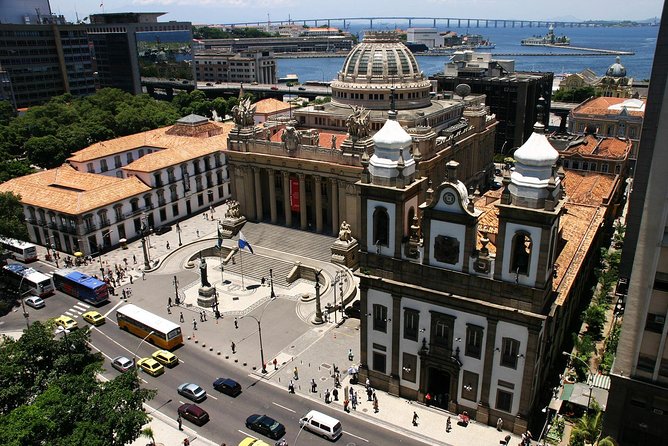
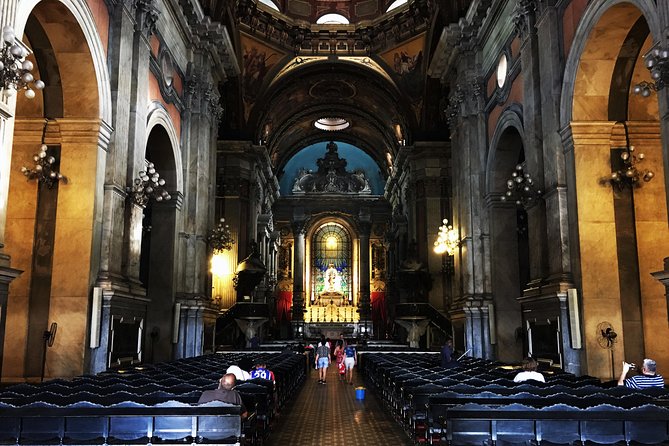
The tour begins at the Church of Our Lady of the Candelária. This one is not a quick photo stop. You get time to see it and, since admission is listed as free, you can visit.
Construction started in 1630 and finished in 1775, and the church is built in a neoclassical style. That long build window changes how you see the details. Instead of a single era, you notice how the design carries the weight of generations.
This first stop does two things for you. First, it gets you oriented to Old Rio’s scale. Second, it sets a tone of formal architecture and ceremony before the route moves into monasteries, squares, and palace-era buildings.
City loops we timed around Rio de Janeiro
- Rio: Carnival Backstage Tour at Samba City with Cocktail
★ 4.6 · 520 reviews - Rio de Janeiro: Private Guided City Tour
★ 4.6 · 207 reviews - Rio de Janeiro: Half-Day Christ the Redeemer and City Tour
★ 4.4 · 101 reviews - Rio Samba Bus: hop-on hop-off city tour in Rio de Janeiro
★ 3.8 · 94 reviews - Learn the History of Rio with an Unforgettable City Center Walking Tour
★ 5.0 · 82 reviews
São Bento Monastery: Paintings and Gilt Carvings Close Up
Next is the Mosteiro de São Bento, a monastery considered one of Brazil’s important architectural patrimonies. It was founded in 1590 by two monks from Bahia, which is a detail worth holding onto as you look around. It reminds you that Rio was never isolated. Religious and artistic influence moved across the country.
This is the stop that many people remember. The monastery has interior art you can take in slowly, including paintings and ornate gilt carvings. Even if your visit time is around 10 minutes, you will likely feel the impact more than you expect, because it is dense with visual information.
One review theme that shows up again and again: guides who know how to pace this moment tend to leave you with real context, not just a checklist. If you care about art and symbolism, ask your guide what to look for first, then let your eyes follow.
Praça XV de Novembro: The Square Where Empire Moments Happened
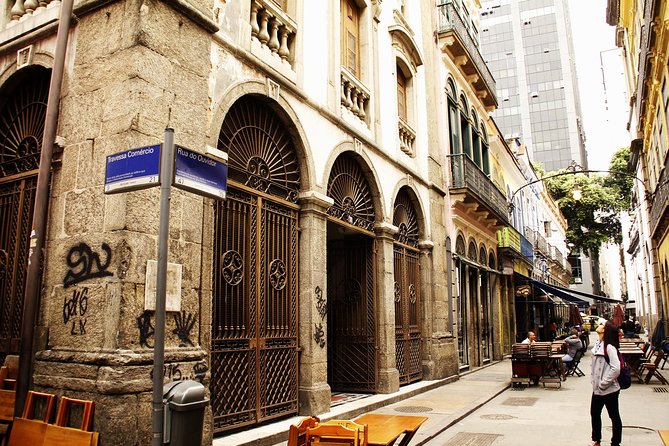
From there, you pass through Quinze de Novembro Square (Praça XV do Novembro). This is a turning point in the tour’s story. You are moving from religious heritage into the stage where political power got dramatic.
The square is tied to Brazil’s imperial era, including the 1800s period when emperors were crowned there. It also hosted other important historical events, which helps you understand why this part of downtown is still a magnet for institutions and monumental buildings.
Walking here also makes sense geographically. It is the kind of place where routes connect. You are not just visiting a spot. You are learning how the downtown grid links buildings, markets, and civic landmarks.
Paço Imperial: A Portuguese-Style Palace With Two Lives
Then comes the Paço Imperial (Imperial Palace). The key idea is that this building was designed as a home and workplace for Brazil’s rulers in the 1700s. Even the style is part of the story: it is described as Portuguese-style.
It gets even more interesting when you look at its later life. The residence served governors of the captaincy and also became the residency of the Portuguese Royal Family when they arrived in Brazil. In other words, this was not only an official building. It became a living space tied to major historical shifts.
If you enjoy architecture, ask your guide how the building’s function changed over time. It is one of those stops where the exterior clues feel obvious once you have the timeline in your head.
Downtown Market Streets and Tiradentes Palace Views
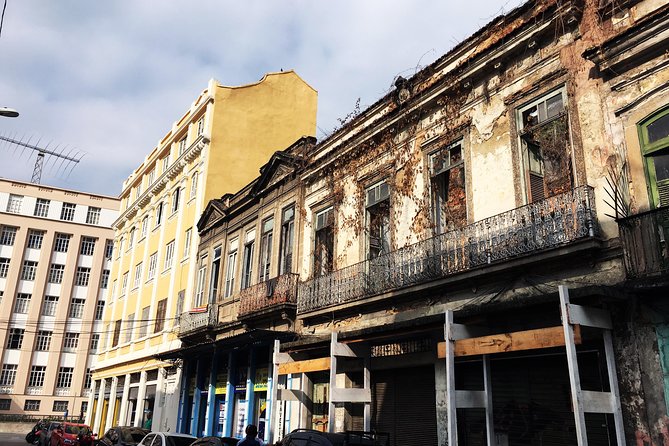
As you continue, you will pass through famous market streets in Rio’s downtown. Even without shopping, these lanes add texture. They remind you that history is happening in the same streets that locals still use today.
You also get to see Tiradentes Palace from outside. That viewpoint angle matters. You are not being asked to stand in a long queue. You are being shown the presence of the building in the downtown power corridor.
This portion of the walk is especially useful if you want to plan the rest of your day afterward. You start to recognize intersections and landmark silhouettes that help you navigate later.
Confeitaria Colombo: The Sweet, Old-Rio Reset
About three stops later you get a break at Confeitaria Colombo, the famous Colombo Bakery. You get about 20 minutes to see and visit.
This is one of the smartest inclusions in the tour because it breaks the momentum. Downtown architecture and squares can make your brain spin. A bakery stop gives you an easy reset, even though food is not included in the tour price.
If you want value, decide in advance what you will actually order. You will have a short window, so it is best to pick something that feels like a quick taste of Rio rather than a full meal.
Uruguaiana Street to the Metropolitan Cathedral
Now the route shifts toward a cluster of iconic downtown landmarks. You stroll down Uruguaiana Street, and the tour connects you toward the Metropolitan Cathedral of Saint Sebastian and Carioca Square.
You are still in “downtown Rio” mode here, but the architecture changes the vibe. Instead of palace and church ornamentation, you get a monumental modern-religious statement.
If you have not spent much time in central Rio, this is where the tour earns its keep. It shows you how neighborhoods and landmarks flow into each other, so your self-guided walking afterward feels less random.
Museum of Tomorrow and Mauá Square, the Olympic-Era Turn
One of the most distinctive parts of this tour is the stop at Mauá Square, described as a gift from the Olympic legacy. This is not just a background detail. It is a reason the area feels different than older downtown sections.
At Mauá Square, you have stops and viewpoints connected to:
- Rio Art Museum
- Museum of Tomorrow
- Cobra murals
There is also a mention of a guide possibly helping with transport around the Museum of Tomorrow area, which can be nice if you do not want to over-walk in the heat or if the timing does not match your own pace.
What you should take from this section is the contrast. Old Rio built identities with palaces and churches. Olympic-era planning tried to build new cultural pull. When you see these pieces in one afternoon, the city’s “then and now” makes more sense than it does from photos alone.
Metropolitan Cathedral: The Conical Giant You Can See and Measure
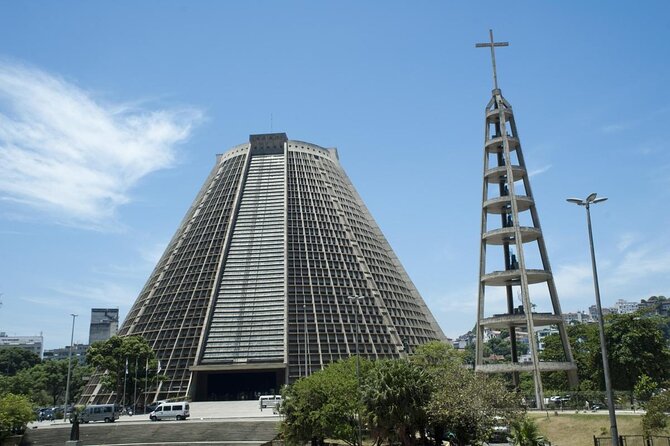
The final major landmark is the Metropolitan Cathedral of Saint Sebastian. The tour time at the cathedral is listed around 10 minutes, but the building is so striking that you will still feel like you got something.
The cathedral is described as a conical cathedral with big scale numbers:
- 96 metres internal diameter
- 106 metres external diameter
- 75 metres overall height
Even if you do not do the math in your head, those measurements tell you the building is designed to be seen from far away and to feel overwhelming up close. This is the kind of stop where photos look great, but your eyes might be surprised by how space-heavy it feels in real life.
The tour ends around this area, and you can explore on your own or take your ride back to your hotel.
The Guide Factor: André, Melanie, JB, and Flexibility
A repeated theme in the experience is that the best days come from the guide’s energy and pacing. Names that show up with strong praise include André, Melanie, JB (often used for Juan Baptiste), and Jean-Baptiste.
When guides are at their best, you get:
- Clear storytelling tied to what you are looking at
- Time management that keeps you moving but not frantic
- The ability to answer questions on-the-spot
- A sense of being safe while navigating downtown streets
One caution from the less happy experiences: a few people felt rushed or that the guide stuck to a rigid checklist. So if you prefer a slow, arts-first style, aim your questions early. A good guide will adjust, especially when the group is small.
Also, since some guides are comfortable shifting between languages for mixed groups, it helps to bring your main questions ready. If your Spanish or Portuguese is basic, a simple, direct question in English often does the trick.
Who This Walking Tour Fits Best
This tour is best for you if you want:
- A guided introduction to downtown Rio’s layout
- A mix of major churches, squares, and iconic civic buildings
- Stops that connect history to the city you see today
It is not ideal if you:
- Cannot handle a steady pace with real city walking
- Hate being constrained by set stop times
- Need a very slow, fully unhurried museum-style visit
For first-time Rio visitors, this is a strong choice. It is also useful early in your trip because you learn what to return to later, whether that is more time in a church interior, a longer look at palace architecture, or simply walking those streets again at your own speed.
The Big Takeaway: Why This Tour Feels Efficient
You get a lot of “Rio meaning” packed into one afternoon. You see the religious foundations, the imperial storyline, the downtown civic core, and then the Olympic-era cultural shift at Mauá Square.
Even the stops that feel short, like 10-minute cathedral or monastery visits, work because the buildings are the main event. This tour does not ask you to understand everything at once. It gives you anchors. Then you can build from there.
Should You Book This Rio City Walking Tour?
Book it if you want an efficient introduction to Old Rio plus Olympic-era modern Rio, and you like the idea of a guide coordinating hotel pickup, a timed route, and major landmarks. The combination of included transfers, central sights, and an 1:00 pm start makes it easy to fit into a first or second day.
Skip it or swap to something else if you are sensitive to pacing, dislike walking enough to feel rushed, or you prefer fewer stops with longer stays. Also, if you are traveling on a day with heavier-than-usual traffic, expect your time on the move to feel less strictly “on foot.”
If you book, do one smart thing: wear comfortable shoes and use the guide’s first explanations. The tour hits harder when you know what you are looking at, not just where you are standing.
FAQ
How long is the Rio city walking tour?
The tour runs for about 4 hours.
What time does the tour start?
The start time is 1:00 pm.
Where does hotel pickup and drop-off happen?
Pickup and drop-off are included for most hotels in São Conrado, Leblon, Ipanema, and Copacabana.
Is food included in the price?
No. Food and drinks are not included.
Are any admissions included?
Some stops list free admission tickets, including the Church of Our Lady of the Candelária and the São Bento Monastery, and other key sights during the tour.
What kind of walking fitness do I need?
The tour is listed for travelers with a moderate physical fitness level.
What is the maximum group size?
The tour has a maximum of 35 travelers.
What if weather is bad?
The tour requires good weather, and if it is canceled due to poor weather, you are offered a different date or a full refund.
Everything Else We Rated in Rio de Janeiro
More Tour Reviews in Rio de Janeiro
More Tour Reviews in Rio de Janeiro
Latest from our Rio de Janeiro notebook
- Unforgettable Boat Party★ 5.0 · 3 reviews
- Tijuca National Park and all its wonders!★ 5.0 · 3 reviews
- Rocinha Jeep Tour: A Journey into the Soul of the Favela!★ 3.8 · 3 reviews
- Rio: Favela Walking Tour of Rocinha with a Resident Guide★ 4.7 · 3 reviews
- Rio: Private, Custom express, Main Attractions!★ 5.0 · 3 reviews
- Rio: Museum of Tomorrow, Yup Star & Olympic Boulevard★ 3.7 · 3 reviews
Historical Tours, compared.
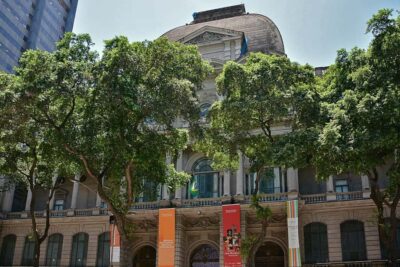 ★ 4.4Historic Rio and Santa Teresa Half-Day TourFrom $47228 reviews
 ★ 4.9Downtown Historical Bike TourFrom $85191 reviews
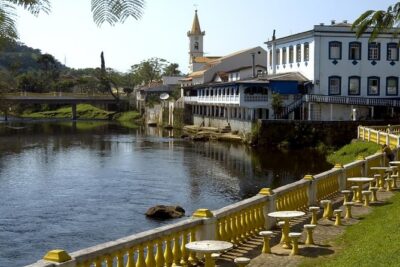 ★ 4.0Scenic Train ride to historical cities of Morretes and AntoninaFrom $128188 reviews
 ★ 4.9Little Africa Heritage Walking TourFrom $40177 reviews
 ★ 4.4From Foz do Iguazu: Triple Frontier Landmark TicketFrom $24136 reviews
 ★ 5.0Explore Little Africa : Unveiling Afro Heritage in Rio de JaneiroFrom $8297 reviews
 ★ 4.8Historic Centre Walking Tour & Cachaça TastingFrom $1996 reviews
 ★ 5.0Downtown-Center History Walking Tour – in EnglishFrom $3191 reviews
Browse the lists this tour appears in